

Your chart reading can be right and the trade can still disappoint. Nifty moves your way, but the premium barely reacts. Or the premium spikes faster than you expected and gives it all back in two candles. Or price simply goes flat, and your small profit slowly melts. Each of these has a name, and once you know it, the trade stops feeling random.
Why the premium does not copy the index
An option premium reacts to more than direction. It also reacts to how sensitive the strike is to movement, how much time is left until expiry, and how much movement the market expects. The Greeks are the names for these sensitivities.
| Greek | Question it answers | What you notice while scalping |
|---|---|---|
| Delta | How much does the premium move when the index moves one point? | The premium moves with Nifty, but by less |
| Gamma | How fast does delta itself change as the index moves? | The premium starts to accelerate once the move builds |
| Theta | How much value does the option lose as time passes? | The premium fades when price goes flat |
| Vega | How much does the premium change when implied volatility changes? | The premium drops or jumps even though Nifty has not moved |
You do not need to calculate any of these during a trade. You need to recognise them when you see them on the premium chart. The option chain on SAHI, and our live option chain, show the Greek values for each strike if you want to check a number.
Delta: how much the premium moves
Delta tells you roughly how many rupees the premium changes when the underlying moves by one point.
- Call delta runs from 0 to 1. Calls gain when the index rises.
- Put delta runs from −1 to 0. The minus sign means puts gain when the index falls, and lose when it rises.
An at-the-money (ATM) option, whose strike is closest to the current price, has a delta near 0.5. If Nifty rises 100 points, an ATM call should gain about 50 points.
Expected premium change ≈ delta × points moved by the indexATM call, delta 0.5, Nifty +100 points → premium ≈ +50
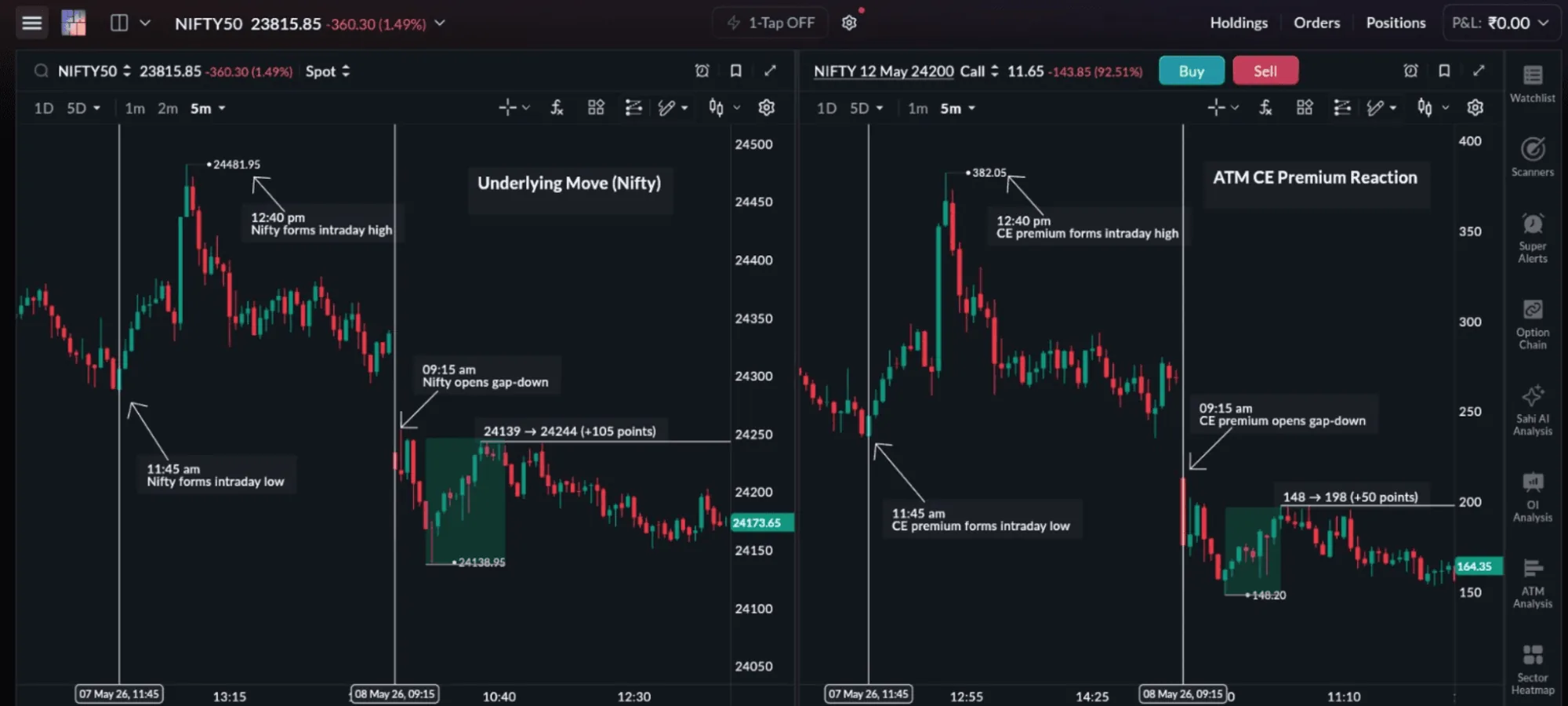
Delta decides how fast your strike responds
Different strikes react differently to the same Nifty move:
| Strike | Typical delta (call) | Premium behaviour | For scalping |
|---|---|---|---|
| ITM (in the money) | Above 0.5 | Moves the most points for each index point, but costs more | Strong response; higher capital per lot |
| ATM (at the money) | Around 0.5 | Balanced movement | Commonly preferred |
| OTM (out of the money) | Below 0.5 | Cheap, but reacts slowly at first | Often too slow for a short holding window |
Strike selection is not about the cheapest premium. A correct directional view on a low-delta strike may not move the premium enough within the few candles you plan to hold.
Gamma: why the move speeds up
Gamma is the change in delta for each point the index moves. As Nifty moves towards and through your call's strike, delta rises, so each new point adds a little more to the premium than the last one. That is why a premium seems slow at first and then suddenly accelerates.
Gamma is strongest in ATM options and near expiry. On those days, even a 20 to 30 point move in Nifty can create a sharp spike in premium. The same force works in reverse: when the move pauses or turns, delta shrinks just as fast and gains disappear quickly.
- Late entries feel expensive, because the premium has already accelerated.
- Exits must be quicker, because premium swings become sharper.
- The question is no longer only "which direction?" but also "how fast is the premium moving?".
Theta: the cost of waiting
An option premium has two parts:
Option premium = intrinsic value + time value
- Intrinsic value is what the option is worth if exercised now. A 24,000 call with Nifty at 24,060 has 60 points of intrinsic value. An OTM option has none.
- Time value is everything above that: the price of the chance that the option gains value before expiry.
Theta is the time value lost as time passes. It runs all the time, but you notice it only when price stops moving. In a strong trend, delta gains hide it. In a sideways market, or when you hold a trade longer than planned, it becomes visible. It also speeds up as expiry comes closer.
A common pattern: the trade moves slightly into profit, you wait for a bigger move, price goes flat for 15 or 20 candles, and the premium slowly fades. The trade ends at a much smaller profit, at break-even, or at a loss.
For a scalper, time is a risk. If price has not done what you expected within the number of candles you planned, the setup has weakened, even if the chart still "looks fine".
Vega: when volatility changes the price
Implied volatility (IV) is the amount of movement the market expects, built into the option's price. Vega is how many rupees the premium changes when IV moves by one percentage point. When IV rises, both calls and puts become more expensive. When IV falls, both become cheaper, even if Nifty stands still.
IV often falls after an event has passed or when the market calms down, and it often rises when uncertainty grows. A scalper who buys options when IV is high can be right on direction and still see the premium shrink. Chapter 6 looks at when IV changes and how India VIX helps you read it.
One trade, four Greeks: a worked example
Here is one ATM call followed through a morning, with round numbers for illustration. Nifty is at 24,000. You buy the 24,000 call of the nearest weekly expiry, two days before expiry, at ₹120.
Starting Greeks, for illustration: delta 0.50, gamma 0.00125 (delta rises 0.05 for every 40 points), theta −₹30 per day (about ₹5 per 60 one-minute candles), vega ₹6 per IV point, IV 17%.
| Step | What happens | Nifty | Delta | Premium change | Premium |
|---|---|---|---|---|---|
| 1. Entry | Bounce from support near 24,000 | 24,000 | 0.50 | – | ₹120 |
| 2. Delta | Nifty rises 40 points | 24,040 | 0.50 → 0.55 | +₹21 (0.525 × 40) | ₹141 |
| 3. Gamma | Nifty rises another 40 points | 24,080 | 0.55 → 0.60 | +₹23 (0.575 × 40) | ₹164 |
| 4. Theta | Nifty goes sideways for 60 candles | 24,080 | 0.60 | −₹5 | ₹159 |
| 5. Vega | IV falls from 17% to 15% | 24,080 | 0.60 | −₹12 (6 × 2) | ₹147 |
Read the table step by step:
- Delta. The first 40 points add about ₹21. We use the average of the delta at the start and end of the move (0.525), because delta changes during the move.
- Gamma. The next 40 points add ₹23, not ₹21, because delta is now higher. On expiry day, ATM gamma is much larger and this gap widens sharply.
- Theta. Nifty does nothing for an hour and the premium loses ₹5.
- Vega. A two-point fall in IV takes ₹12 off the premium, more than an hour of theta, without Nifty moving at all.
₹120 + ₹40 (delta 0.5 × 80) + ₹4 (gamma) − ₹5 (theta) − ₹12 (vega) = ₹147
Nifty gained 80 points. A simple "delta 0.5" estimate said the premium should be ₹160. It ended at ₹147. Nothing was wrong with the chart; time and volatility took their share.
Illustrative numbers. In a live market all four Greeks change continuously; here gamma, theta and vega are held steady to keep the arithmetic simple, and theta during the rise (about ₹2) is left out.
- Up
- Down
- 24,000 call premium
- Entry. Nifty holds near 24,003 and the premium is about ₹121.
- Delta. 14 candles later Nifty is at 24,043. The first 40 points have added about ₹20.
- Gamma. 7 candles later Nifty is at 24,085. The next 42 points have added about ₹24, more than the first leg.
- Theta. For the next 35 or so candles Nifty moves sideways between roughly 24,060 and 24,095. The premium stops rising and drifts lower.
- Vega. Over three candles IV falls two points. Nifty edges up from 24,079 to 24,082, yet the premium drops from about ₹157 to ₹147.
Expiry day: everything at full strength
On expiry day, ATM gamma is at its highest and the remaining time value is small and disappearing fast. Premiums become:
- faster to move, and more sensitive to small price changes;
- quicker to lose value when price stalls;
- prone to sharp spikes, false breakouts and quick reversals.
An option that is still OTM near the close has no intrinsic value, so whatever time value remains will decay to almost zero by expiry, whatever the index did earlier in the day.
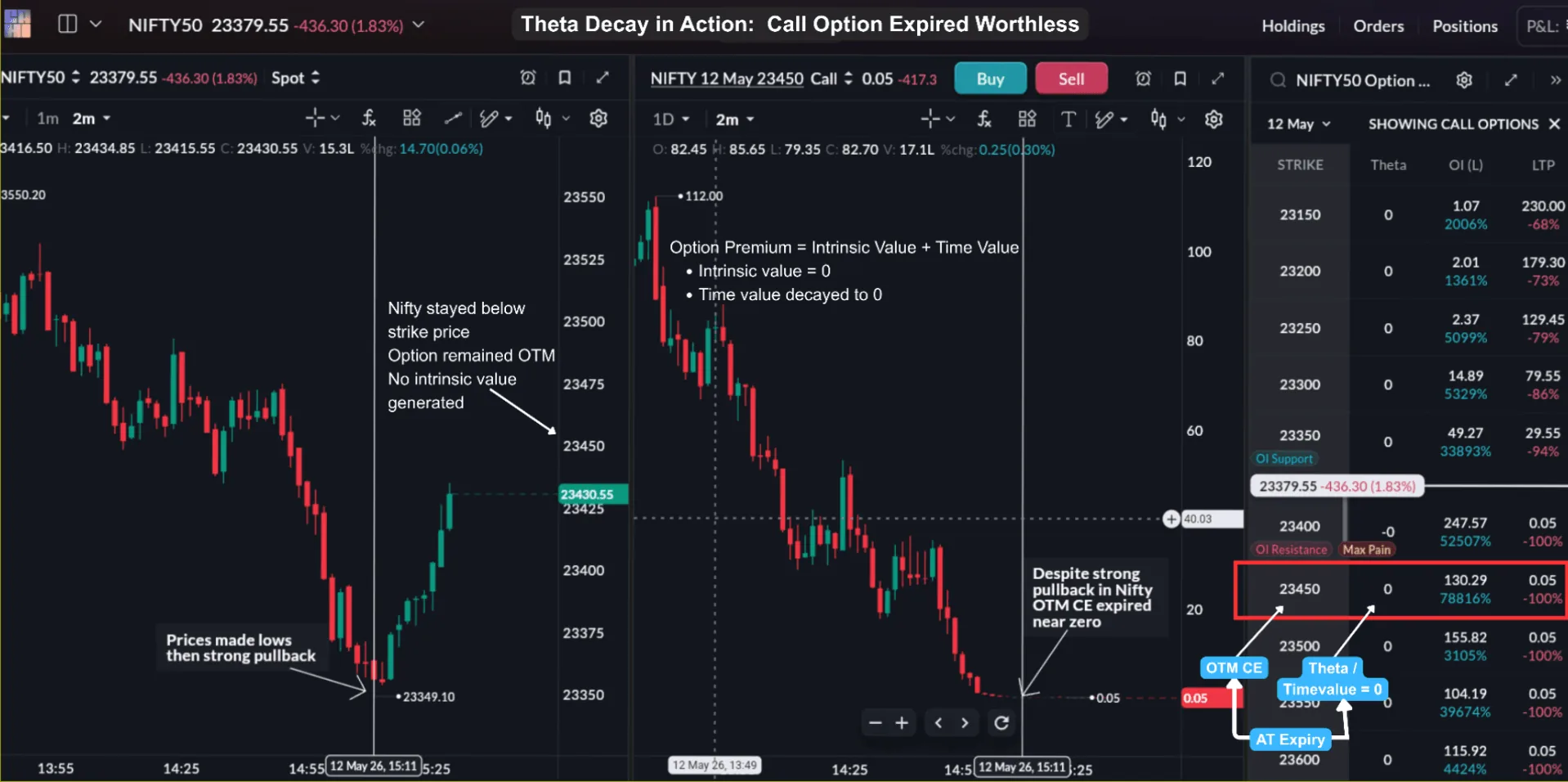
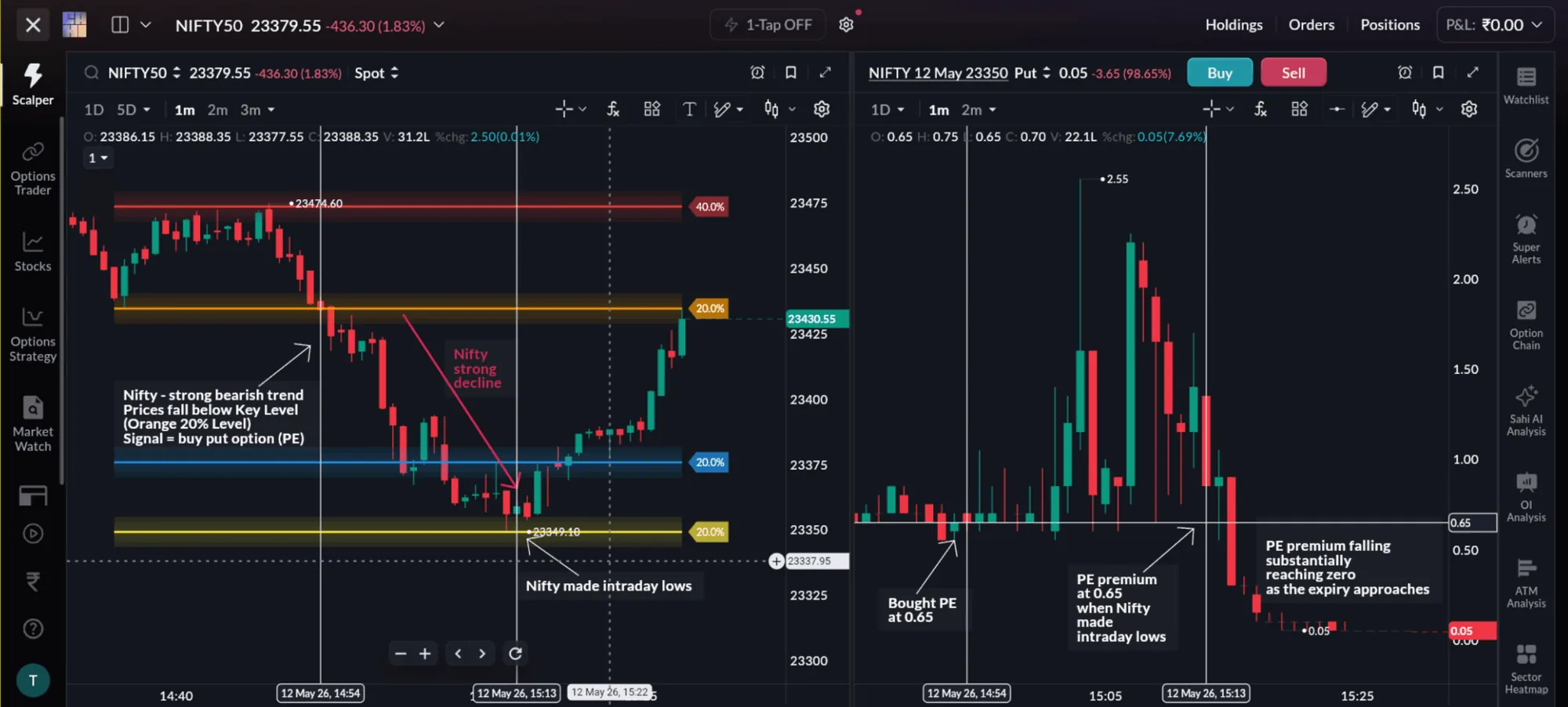
On expiry day, scalping is less about prediction and more about execution: a precise entry, a quick exit, and no hesitation. The longer you hold without momentum, the more gamma and theta work against you at the same time.
Using the Greeks in a live scalp
In a live trade you read the Greeks through the premium's behaviour. Each one matters at a different stage:
| Stage | Greek | What to observe | What to do |
|---|---|---|---|
| Before the trade | Delta | How responsive the strike is | Choose ATM, or slightly ITM, so the premium follows the move |
| Before the trade | Vega | Whether IV is unusually high, for example before an event | Expect the premium to lose value if IV falls after the event |
| During the move | Gamma | The premium accelerating | Trail the stop and be quicker to book, especially near expiry |
| While holding | Theta | The premium fading while price is flat | Exit if price has not moved within your planned number of candles |
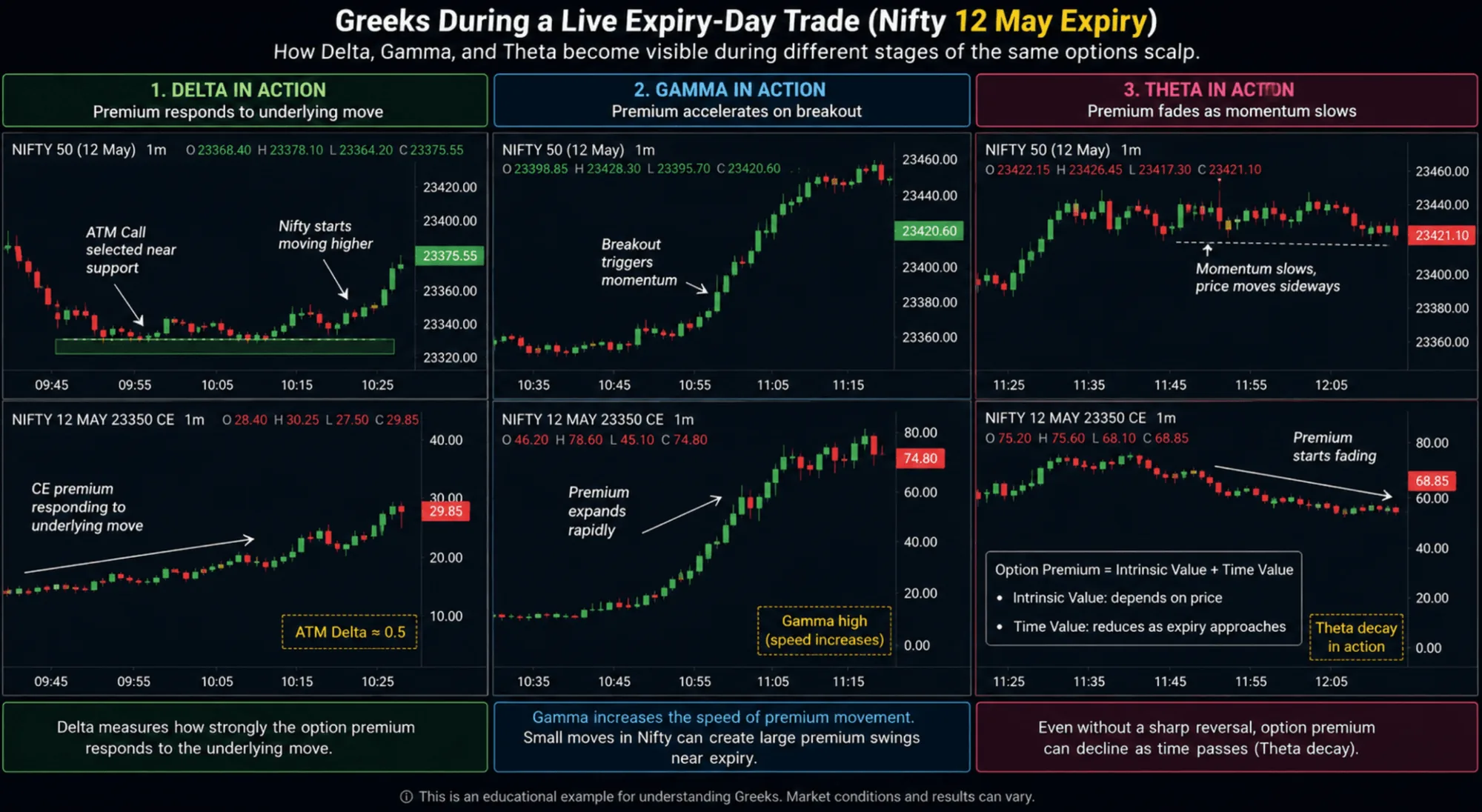
Two simple habits make this practical:
- Watch the premium chart, not only the index. Keep the Nifty chart and your option's chart side by side, on the same timeframe.
- Set a time stop as well as a price stop. Decide before entry how many candles the move should take. If it has not happened by then, exit.
The Greeks explain how the premium behaves. Where price is likely to react, and why volatility expands or contracts, is a question of market context. Chapter 6 covers open interest, key levels, India VIX and vega in that light.
Checklist
- Delta: expected premium change ≈ delta × index points. ATM ≈ 0.5.
- Pick a strike that responds within your holding window; the cheapest strike is often too slow.
- Gamma makes premiums accelerate near the strike and near expiry, in both directions. Exit faster.
- Theta takes value every candle. If price has not moved within your planned candles, get out.
- Vega: a fall in IV can shrink a premium even when Nifty goes your way.
- On expiry day, execution beats prediction.
Questions
Do I need to calculate Greeks during scalping?
No. In intraday scalping, decisions are based on observation rather than calculation. Knowing how the premium behaves (responding, accelerating, fading) is more useful than tracking exact Greek values during a trade.
Why does my option premium not move even when the index moves?
This usually happens with low-delta options, especially far OTM strikes. The move in the index is not large enough to change the premium much. A fall in implied volatility can also cancel part of the gain.
Why do profits disappear even when price is stable?
This is usually theta decay. When price does not move, time value keeps reducing the premium. If implied volatility is also falling, the premium drops faster.
Are Greeks more important on expiry day?
Yes. Gamma and theta both become stronger near expiry, so the premium moves faster and reacts more sharply to small price changes.
Which options are commonly preferred for scalping?
ATM options are commonly preferred because they give a balance between responsiveness and cost. Slightly ITM strikes respond more but need more capital; far OTM strikes are cheap but often too slow.
Scalping knowledge check
How well do you read the Greeks?
Five quick questions on delta, gamma, theta and expiry-day behaviour. See where you stand and pick up an insight along the way. Under 5 minutes
-
Show answer
Answer: C. Around 50 points Delta estimates the premium change per point of index movement. An ATM option with delta around 0.5 moves roughly half the index move, about 50 points. Gamma can add a little as delta rises; theta and a fall in IV can take a little away.
-
Show answer
Answer: B. In ATM options near expiry Gamma peaks in ATM options near expiry. Small index moves then cause sharp premium acceleration, in both directions.
-
Show answer
Answer: D. Theta: time decay eating the premium while price stalls Time value erodes even when price does not move. In scalping, time itself becomes a risk when a trade is held too long without momentum.
-
Show answer
Answer: A. High gamma and high theta act together, making premiums faster and more fragile Premiums spike and collapse faster on expiry day, so timing and execution matter more than direction alone.
-
Show answer
Answer: C. No, observe how the premium behaves; understanding beats calculation In intraday scalping the Greeks are read through premium behaviour (responding, accelerating, fading), not calculated in real time.
You got 0 of 5 right.