

Chapter 1 showed what a scalp trade looks like on paper: a level, a confirming candle, a fixed target and stop. This chapter is about the part that paper cannot show, which is you, at the screen, with money at risk and price moving every second.
Why mindset decides results
In slower styles of trading, small mistakes often go unnoticed. A slightly late entry or an early exit may still work out, because the trade has time to play out. Scalping gives no such margin. Decisions are quick and their effect shows almost at once, sometimes within a few seconds of entry. A few points missed on entry, or a stop-loss moved without a clear reason, can change the outcome within minutes.
This is where many traders misread what happened. A trade fails and they conclude that the setup failed. Often the setup was reasonable; the problem was how the trade was taken or managed. Over time this creates a familiar pattern:
- The strategy keeps changing.
- The behaviour stays the same.
The trader keeps searching for a better setup while the real problem sits in execution. Scalping makes this gap very visible, because decisions are frequent and mistakes repeat quickly.
In most scalping approaches it is normal for 3 to 5 out of 10 trades to hit the stop-loss. Profitability comes from how the remaining trades are managed, not from avoiding losses altogether.
Scalping as a business, not a bet
Traders who last in scalping treat it as a process that plays out over a series of trades, not as a string of individual outcomes. They care less about any single trade and more about whether they are following a repeatable way of working. A business runs the same way:
- Defined processes
- Known costs
- Performance measured over time
Know your cost of doing business
Cost is the part most often overlooked. Every trade in India carries statutory charges, namely STT, exchange transaction charges, GST and stamp duty, which apply whichever broker you use. On top of these is brokerage, the most visible cost, which grows directly with the number of trades and is one of the few costs you can choose. Combined, these costs can take 30% to 40% of gross profits when targets are small and trades are frequent.
Small differences in brokerage become large at scalping frequency. Here is the arithmetic for 20 trades a day over 20 trading days:
| Scenario | Brokerage per trade | 20 trades a day | Month (20 days) |
|---|---|---|---|
| Lower-cost broker (for example SAHI) | ₹10 | ₹200 | ₹4,000 |
| Typical brokerage | ₹20 | ₹400 | ₹8,000 |
The real gap is slightly more than ₹10 a trade, because 18% GST is charged on brokerage. That pushes the difference to about ₹11 to ₹12 a trade. At a few trades a month you can ignore it. At scalping frequency it decides whether a month ends in profit.
Judge the process, not the trade
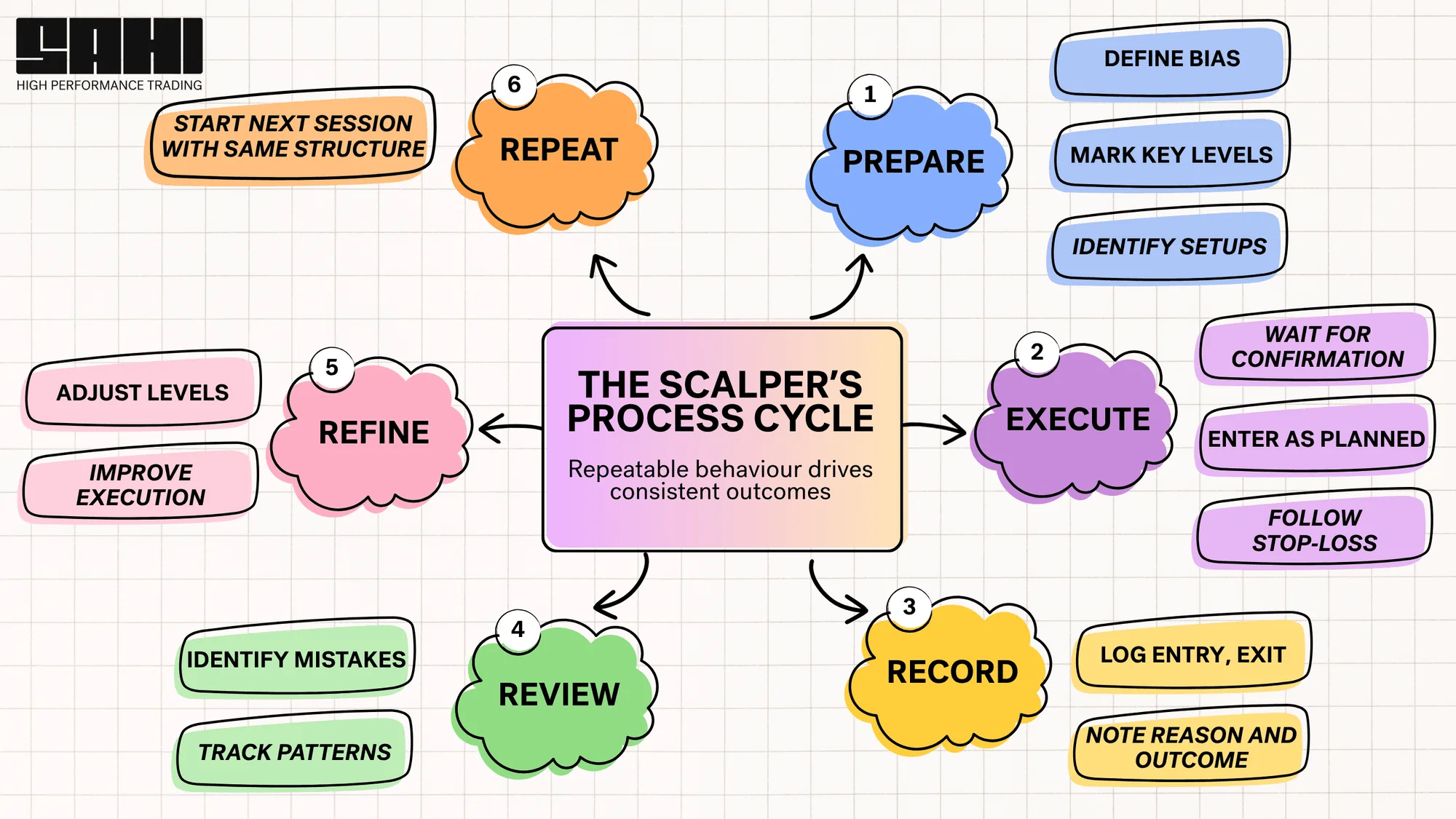
Costs are one half of the business. The other half is how decisions are made through the session. When decisions are not anchored to a system, they drift with whatever just happened. A winning trade feels like confirmation; a losing one creates an urge to recover quickly. Soon trading looks like a series of bets rather than a controlled process.
Instead of asking "Did I make money on this trade?", ask "Did I execute this trade the way I planned?" Across sessions this one change makes behaviour steadier, and results build on that steadiness.
Decision speed comes from preparation
Scalping needs quick decisions, but the quality of those decisions is set before the market opens. Once the session starts, price is moving, premiums are reacting and there is little time to analyse from scratch. In that environment, clarity matters more than speed.
In active instruments such as Nifty or Bank Nifty options, trades often play out within 30 seconds to 5 minutes. On a 1-minute chart that is one to five candles: very little room for delayed decisions or second thoughts.
Clarity comes from three things done in advance:
- Key levels are marked: the previous day's high and low, the opening range, recent swing highs and lows.
- Setups are defined: for example, a rejection at support, or a breakout that closes beyond a level and then holds a retest.
- There is a rough bias: which side you prefer today, and what would change your mind.
With this done, decisions feel quick without being rushed. The trade is not discovered in the moment; it is recognised. Without it, speed works against you. Entries happen because price is moving, sometimes within seconds of a candle forming, not because a setup is complete. Trades feel urgent and get justified after they are taken instead of before.
During market hours your job is execution. If the planned conditions are present, take the trade. If they are not, wait. Be comfortable not trading for stretches of 20 or 30 candles. In very active instruments the pull to stay involved is strong, but without a clear setup, activity adds noise, not value.
Three psychological traps
Once decisions start reacting to what is happening on the screen, the same three patterns appear again and again.
FOMO: the fear of missing out
You watch Nifty move 40 to 50 points in a few minutes without you. Candles keep closing in the same direction, and the urge to enter grows because the move is already obvious. By the time you enter, the risk-reward has already shifted against you: the stop that makes sense is now far away, and the room left to the target is small.
Revenge trading
A stop-loss is hit, and almost at once comes the urge to take another trade to win it back. The last trade is still on your mind, and the next entry feels urgent rather than planned.
Overtrading
A few good trades bring confidence. Activity rises, but the quality of trades falls. Gains from the good trades are handed back through unnecessary ones.
| Trap | What triggers it | What it does | Rule that stops it |
|---|---|---|---|
| FOMO | A fast move you are not part of | Late entry, far stop, poor risk-reward | Enter only at a marked level; a missed move is let go |
| Revenge trading | A stop-loss just hit | Unplanned entry to recover the loss | Pause after a loss; wait for the next valid setup |
| Overtrading | A run of winners, or a very active market | Lower-quality trades that give back gains | A fixed number of setups and a daily limit |
The root of all three is the same: decisions shaped by recent outcomes rather than by a structure set in advance. In the moment each decision feels reasonable. The pattern becomes clear only after the session.
That is why the damage is slow, not sudden. In active sessions, scalpers often take 10 to 50 trades a day. At that frequency even small lapses in discipline can turn a marginally profitable approach into a losing one over a few weeks. Accounts drift down not because of one large loss, but because of small, repeated decisions that work against you. Experienced scalpers handle this by stepping aside when conditions are unclear and treating waiting as part of the job.
The discipline framework
The traps repeat because decisions are being made in the moment, under pressure. Discipline in scalping means the important decisions are already made, in writing, before the session begins. At a basic level the framework has four parts:
- Defined entry conditions. The level and the candle you need to see. These can come from price action alone, or from price levels confirmed by tools such as RSI, Bollinger Bands or the key levels on the SAHI chart. What matters is that they are written down.
- A stop-loss set before the trade. Placed where the setup is proven wrong, not where the loss feels comfortable.
- A clear exit plan. A target with a defined risk-to-reward, for example 1:2.
- Session-level limits. A maximum daily loss or a maximum number of trades, after which you stop for the day.
These rules matter most at the exact moments you want to break them: the trade moves slightly against you and the stop is close, or a loss creates the urge to recover. The chart below shows the same opportunity traded two ways.
- Up
- Down
- Range
- Range high 25,010
- Breakout. After 18 candles in a 24,980 to 25,010 range, a candle closes at 25,022, above the range high, on the tallest volume bar of the session.
- Planned entry on the retest. Six candles later price returns to the old range high on light volume. The candle dips to exactly 25,010 and closes at 25,016. The planned trader buys here, with the stop at 25,000 and the target at 25,048.
- Target reached. Five candles after entry the high touches 25,049. The planned trade is closed for +32 points.
- The chase. Four candles later, after a run of about 50 points from the range high, a trader with FOMO buys at 25,058, near the top of the move.
- The pullback. Seven candles after the chase, price has slipped to 25,024. The chaser is 34 points down, and price does not trade above 25,058 again on this chart.
| For illustration | Case 1: framework followed | Case 2: framework not followed |
|---|---|---|
| Entry | 25,016, at the planned level after the retest | 25,058, late, after the move is obvious |
| Stop-loss | 25,000, fixed before entry (16 points) | Not defined; the logical stop is still below 25,000 (58 points) |
| Target and risk-to-reward | 25,048 (+32 points), 1:2 | Unclear; the same 32 points would risk 58, about 1:0.55 |
| Management | The trade is left alone to play out | Hesitation, early exits, or a loss allowed to grow in hope of a reversal |
| Result on this chart | +32 points, closed | 34 points down at the pullback low |
The opportunity was the same. The outcome was different because one trader followed a plan made in advance and the other reacted to the screen. With the framework, execution becomes mechanical, not reactive, and the result of any single trade, profit or loss, is accepted as part of the process.
Why discipline beats strategy
It is easy to assume that better setups lead to better results. In practice, execution matters at least as much. In scalping, small deviations compound quickly.
₹2 move in a Nifty option × 65 units in one lot = ₹130 per lot
Across 15 to 20 trades, moves of this size can build into meaningful profits, but only if execution is consistent. Now consider two traders using the same setup. The first follows the plan closely. The second makes small adjustments: one entry is a little late, reducing the reward; another trade is exited early, locking in less; a third moves against the position and the stop-loss is moved instead of respected. Over a few trades the difference is hard to see. Over a full session, and then over weeks, the gap is clear.
The setup never changed; the outcome did. A strategy that works on paper underperforms in practice. Average setups executed with discipline usually produce steadier results than strong setups traded without control.
In scalping, discipline is not a support to the strategy. It is part of the strategy.
The professional scalper's day
Consistent scalpers stand out less by what they trade and more by how they trade:
- They act without hesitation when the setup is clear.
- They feel no urgency when it is not.
- They let missed trades pass without chasing them.
- Their execution follows the same pattern from trade to trade.
- A win does not lead to more risk, and a loss does not create pressure to recover. The session is judged by how closely it followed the plan, not by the final P&L.
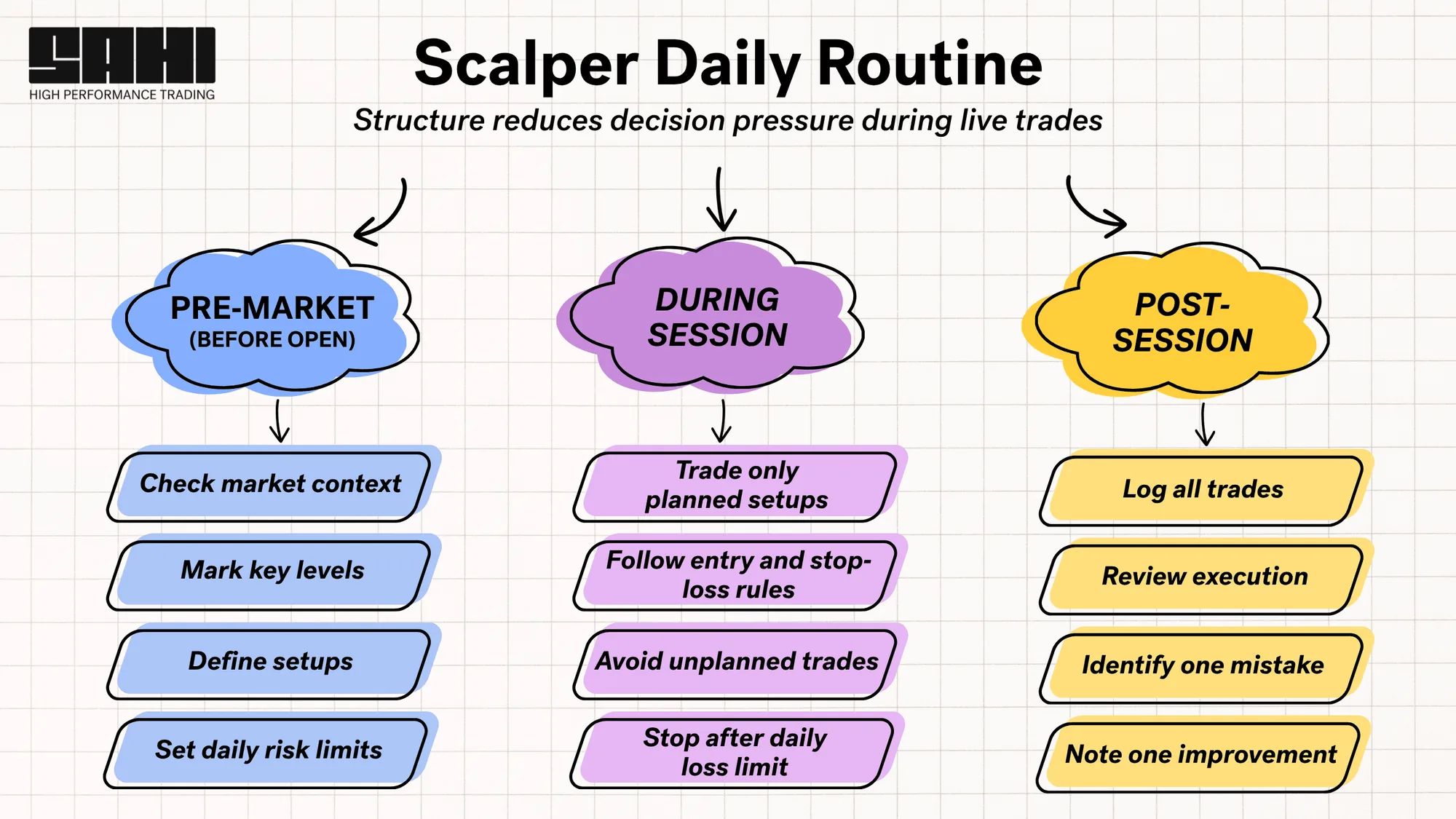
That steadiness comes from a simple structure around the trading day:
| When | What you do |
|---|---|
| Before the market | Review the context, mark key levels, define setups, set daily risk limits |
| During the session | Trade only planned setups, follow entry and stop-loss rules, stop at the daily loss limit |
| After the session | Log every trade, review execution, find one mistake, note one improvement |
Are you built for scalping?
Scalping depends on consistent decision-making, so step back and look at how you actually behave in a live session. Answer each question honestly with yes or no.
- Can you stay focused on charts for 45 to 90 minutes at a stretch without distraction?
- Can you be available consistently during active market hours?
- Do you follow predefined rules even when instinct says otherwise?
- Can you accept a stop-loss without immediately trying to recover it?
- Are you comfortable waiting when there is no clear setup?
- Do you define risk before entering every trade?
- Can you stop trading once your daily limit is reached?
- Do you avoid entering trades just because the market is active?
- Do you review your trades regularly and identify mistakes?
- Can you stay neutral after both winning and losing trades?
| Your answers | What it usually means |
|---|---|
| Mostly yes | The basic behavioural fit is in place. |
| Mixed | Parts of your approach work; others need more consistency. |
| Several no | These are the areas where your decisions are likely to drift during a session. Work on them first, at small size. |
Checklist
Mindset keeps your decisions consistent and stops small mistakes from becoming large ones. But consistency alone is not enough. The next chapter covers risk and money management: how much you trade, how losses are limited and how capital is protected. If mindset decides how you behave in a trade, risk management decides how long you stay in the game.
- Losing 3 to 5 trades out of 10 is normal; results come from how the rest are managed.
- Know your full cost per trade; at scalping frequency, costs can take 30% to 40% of gross profit.
- Mark levels and define setups before the open, so that in the session you only recognise them.
- Name the trap when you feel it: FOMO, revenge or overtrading. A missed move is let go.
- Write the framework down: entry conditions, stop before entry, exit plan, daily limits.
- Judge each trade by one question: did I execute it the way I planned?
Questions
I understand the rules but still break them during live trades. What should I do?
Reduce your position size until a single loss no longer triggers an emotional reaction or changes your behaviour mid-trade. When you can follow the plan consistently at that size, increase it gradually. The goal is to train execution, not to test setups under pressure.
Is it normal to feel pressure or anxiety while scalping?
Yes. The fast pace and instant feedback of scalping create pressure for most traders, and it rarely goes away completely. What matters is whether the pressure changes your decisions. With good preparation and clear rules, the intensity usually falls over time as execution becomes automatic.
What should I do immediately after a losing trade?
Pause, and wait for the next valid setup instead of reacting. A stop-loss hit often triggers the urge to recover quickly, which is exactly when decisions drift from the plan. Stepping away for a few minutes resets your focus and protects the rest of the session.
How important is preparation before the session, and what should it include?
Very important. It removes the need to decide from scratch while price is moving. Before the open, mark key levels, define your setups, form a bias and set your daily risk limits. With this done, trading during the session becomes recognition, not discovery.
How can discipline improve over time?
Through regular review, not willpower. Log every trade, note exactly where execution moved away from the plan, and choose one clear improvement for the next session. Over weeks and months this feedback loop steadily removes small but costly mistakes.
Scalping knowledge check
How strong is your scalping discipline?
Five quick questions on mindset, psychological traps and the discipline framework. See where you stand and pick up an insight along the way. Under 5 minutes
-
Show answer
Answer: B. 3 to 5: losses are a normal part of the process Losing 3 to 5 out of 10 trades is normal. Profitability comes from how the remaining trades are managed, not from avoiding losses altogether.
-
Show answer
Answer: C. "Did I execute this trade the way I planned?" Judging trades by execution rather than outcome keeps decisions anchored to the system. Over sessions, behaviour steadies and results build on that.
-
Show answer
Answer: A. The risk-reward of the trade That is FOMO. By the time the move is obvious and you enter, the logical stop is far away and the room to the target is small, so the risk-reward has shifted against you.
-
Show answer
Answer: D. Stop-loss set before the trade, with session-level limits The framework is set before the session: defined entry conditions, a stop-loss set before the trade, a clear exit plan and session-level limits.
-
Show answer
Answer: B. Small execution deviations compound quickly across many trades A late entry, an early exit, a moved stop: each is small, but across 10 to 50 trades a day they add up. Average setups executed with discipline beat strong setups traded without control.
You got 0 of 5 right.