


Every delivery sell from a demat account needs authorisation. The default, eDIS with TPIN and OTP, expires at the end of each trading day, so a trader who sells on twelve days a month goes through it twelve times. Most of the time, a fast move has faded by the time the OTP is entered.
What DDPI is, and the four things it covers
WhereSAHI appProfileAuthorise sell orders
DDPI stands for Demat Debit and Pledge Instruction: a standard document you sign once, letting SAHI debit shares from your demat account for a fixed list of purposes. SEBI introduced it in April 2022 to replace the broad Power of Attorney brokers used for two decades, and widened it in October 2022.
It covers exactly four things: settling your sell trades; pledging shares for margin; mutual fund transactions on the exchange platform; and tendering shares in open offers, buybacks and delistings. Nothing else.
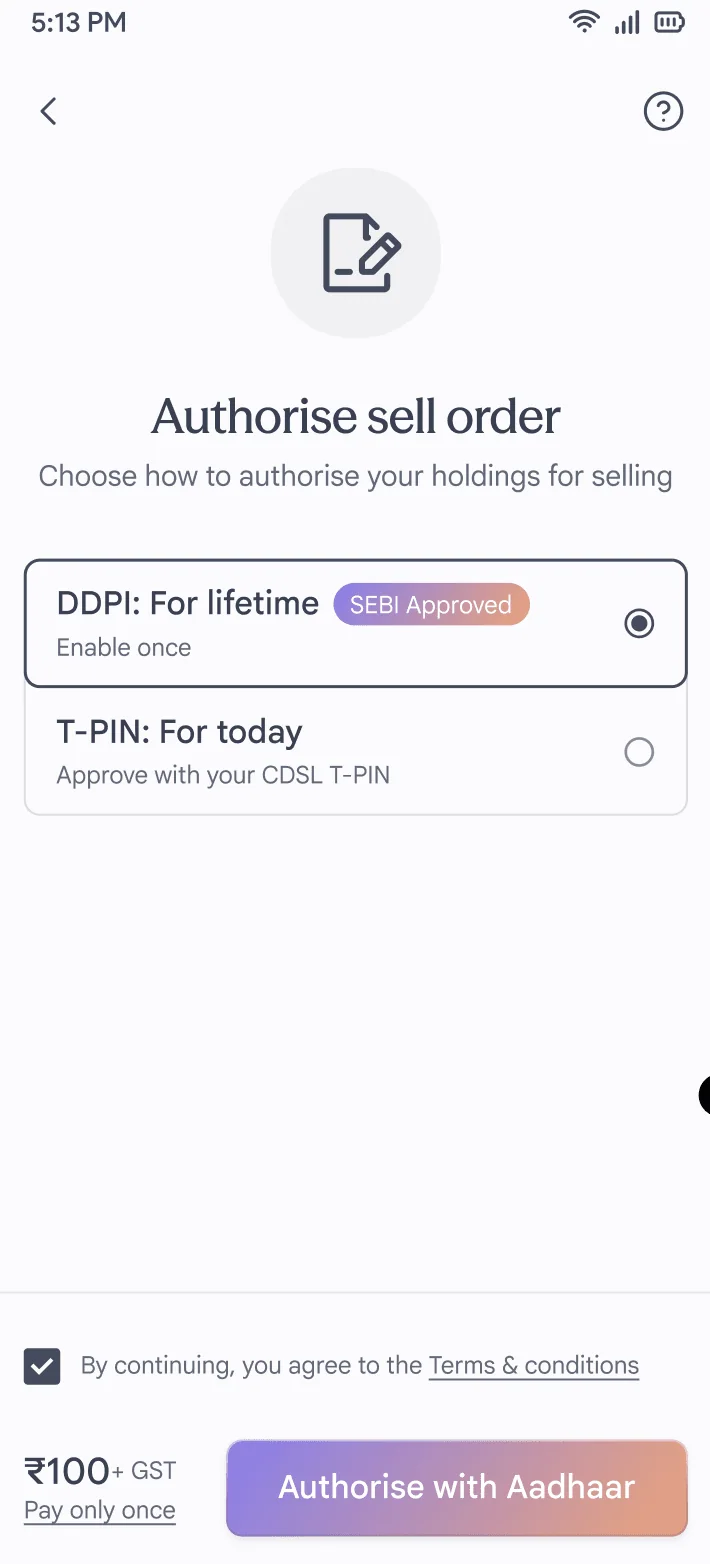 DDPI: For lifetime or T-PIN: For today
- SAHI cannot sell on its own: DDPI only authorises the debit of a sell order you placed.
- Shares cannot go to anyone else's demat account: only to the clearing corporation, or into a pledge for margin.
- Off-market transfers and gifts still need a separate Delivery Instruction Slip.
- It does not touch your bank account or funds, and it has nothing to do with buying.
- It is optional. You can keep using TPIN and OTP.
DDPI, Power of Attorney and TPIN, side by side
WhereHow a sell order is authorised
Three ways to authorise the same debit. DDPI keeps the convenience of the old Power of Attorney with a fraction of its scope.
| Power of Attorney (old) | DDPI | CDSL TPIN (eDIS) | |
|---|---|---|---|
| Scope | Broad, loosely worded | Four defined purposes | One day's sells |
| Effort per sell | None | None | TPIN and OTP each day |
| Valid until | Revoked | Revoked | End of the day |
| Misuse risk | Higher | Low, by design | Lowest |
| Status | Being phased out | Current standard | Always available as fallback |
| Cost on SAHI | Not offered | ₹100 + 18% GST, once | Free |
Switch it on in about two minutes
WhereSAHI appProfileAuthorise sell ordersDDPI
SAHI is its own CDSL depository participant (IN-DP-12100100), so every eligible account completes DDPI online with Aadhaar e-Sign. Nothing is printed, signed on paper or posted.
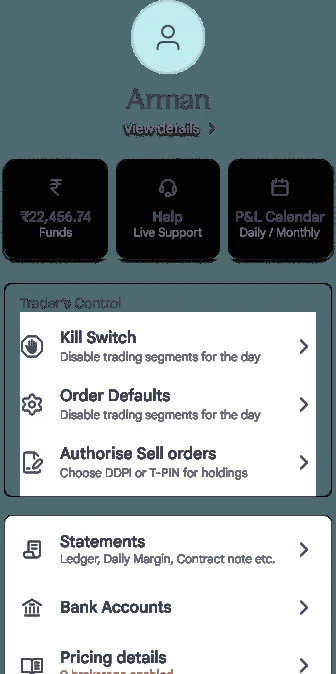 Authorise Sell orders in the profile menu
How to use it5 steps
- In the SAHI app, open your Profile and tap Authorise Sell orders.
- Read the four purposes: they are the legal scope of what you are signing.
- Pick DDPI: For lifetime, tick the terms and tap Authorise with Aadhaar.
- Enter your 12-digit Aadhaar number, give consent and verify with the OTP sent to your Aadhaar-linked mobile.
- The status moves to Under process; activation usually completes within one working day, confirmed by email and SMS.
DDPI costs ₹100 + 18% GST = ₹118, once, debited from your trading ledger. No annual fee, no per-trade cost. Selling holdings twice a month means about 24 TPIN and OTP rounds a year; ₹118 removes all of them for good.
The OTP goes to the mobile linked to your Aadhaar, which may not be the one registered with SAHI. If that number is inactive, the OTP never arrives: the most common reason activation fails.
What changes when you sell
WhereHoldingsSell
Before DDPI: place the sell order, the eDIS prompt opens, verify, enter TPIN on the CDSL page, wait for the OTP, enter it, return to the app. The next day, again. After DDPI: place the sell order. It goes through.
It matters most when you exit on a gap or a news spike, sell several stocks in one session, pledge holdings as F&O margin, or tender shares in a buyback before the window closes.
- Intraday equity and F&O never touch demat, so they never needed TPIN or DDPI.
- Shares bought yesterday are a receivable until credited (T+1); selling them today is BTST and is settled by the broker, not through TPIN or DDPI.
- DDPI covers your SAHI demat account only.
Questions
What is the full form of DDPI?
Demat Debit and Pledge Instruction.
Is DDPI mandatory?
No. SEBI made it optional. Selling with CDSL TPIN and OTP works exactly as before.
How much does it cost?
A one-time ₹100 plus 18% GST, ₹118 in all, debited from the trading account ledger.
How long does activation take?
Usually within one working day of the Aadhaar e-Sign, confirmed by email and SMS.
Can the broker sell my shares once DDPI is active?
No. DDPI authorises the debit only after you place a sell order. It cannot start a trade.
Does it work for mutual funds and buybacks?
Yes: mutual fund transactions on the exchange platform and tendering shares in open offers, which includes buybacks.
Is TPIN still needed after DDPI?
Not for the covered transactions. TPIN stays valid as a fallback; there is no need to delete it.
Can I cancel DDPI later?
Yes. Send a revocation request from your registered email address, quoting your demat account number. Selling then goes back to TPIN and OTP.
Turn on DDPIOpen Profile in the SAHI app and tap Authorise Sell orders. Educational content only, not investment advice.
Open SAHI