Trailing Stop Loss: Meaning, How It Works, and When to Use It
A trailing stop loss moves with your position to lock in profits while limiting downside. Learn how it works with practical examples for Indian stock traders.

A trailing stop loss is a dynamic exit order that moves up (for long trades) as the price rises, but stays fixed when the price falls. It locks in profits automatically without requiring you to manually adjust stops. For example, if you set a 5% trailing stop on a stock at ₹100, your stop is ₹95. If the stock rises to ₹120, the stop moves to ₹114. If it then falls to ₹114, you exit with a profit. Use it in trending markets — not in choppy, sideways conditions.
A standard stop loss does one job: it limits your loss if a trade goes wrong. But once a trade starts going right, a standard stop loss does nothing. It sits at the original price while your profits grow — and if the market reverses sharply, those profits can evaporate before you react.
A trailing stop loss solves this problem. It moves with the price, preserving an increasing portion of your gains as a trade runs in your favour.
How a Trailing Stop Loss Works
A trailing stop loss is defined by a trailing amount, either a fixed number of points or a percentage of the current price. The stop level adjusts automatically as the price moves in your favour. It does not move down if the price moves against you.
Here is a concrete example with Nifty futures:
- You buy Nifty futures at 22,000. You set a trailing stop loss of 100 points.
- Your initial stop is at 21,900 (22,000 − 100).
- Nifty rises to 22,200. Your trailing stop adjusts to 22,100 (22,200 − 100).
- Nifty rises further to 22,500. Your trailing stop adjusts to 22,400 (22,500 − 100).
- Nifty then falls from 22,500 to 22,380. Your stop triggers at 22,400, closing your position at approximately 22,400.
- Result: You entered at 22,000 and exited near 22,400, capturing 400 points, even though the price reversed.
A fixed stop loss at 21,900 would have stayed at 21,900 throughout. You would have had to manually decide when to exit to capture the 400-point gain.
Fixed Stop Loss vs Trailing Stop Loss
| Feature | Fixed Stop Loss | Trailing Stop Loss |
|---|---|---|
| Stop level | Fixed at original price | Moves with price (upward for long trades) |
| Profit protection | None — doesn't lock in gains | Yes — adjusts to preserve rising profits |
| Manual adjustment needed | Yes, to trail manually | No — automated |
| Best for | Defined risk on a single level | Trending moves where you want to ride the trend |
| Risk | No profit-lock mechanism | May exit prematurely in a volatile, choppy market |
Trailing Stop Loss in Points vs Percentage
A points-based trailing stop loss uses an absolute price distance. If Nifty is at 22,000 and you set a 150-point trailing stop, the stop is always 150 points below the highest price reached since your entry.
A percentage-based trailing stop loss uses a proportion of the current price. A 1% trailing stop on a stock at ₹1,000 starts at ₹990. If the stock rises to ₹1,200, the stop adjusts to ₹1,188 (1,200 × 0.99).
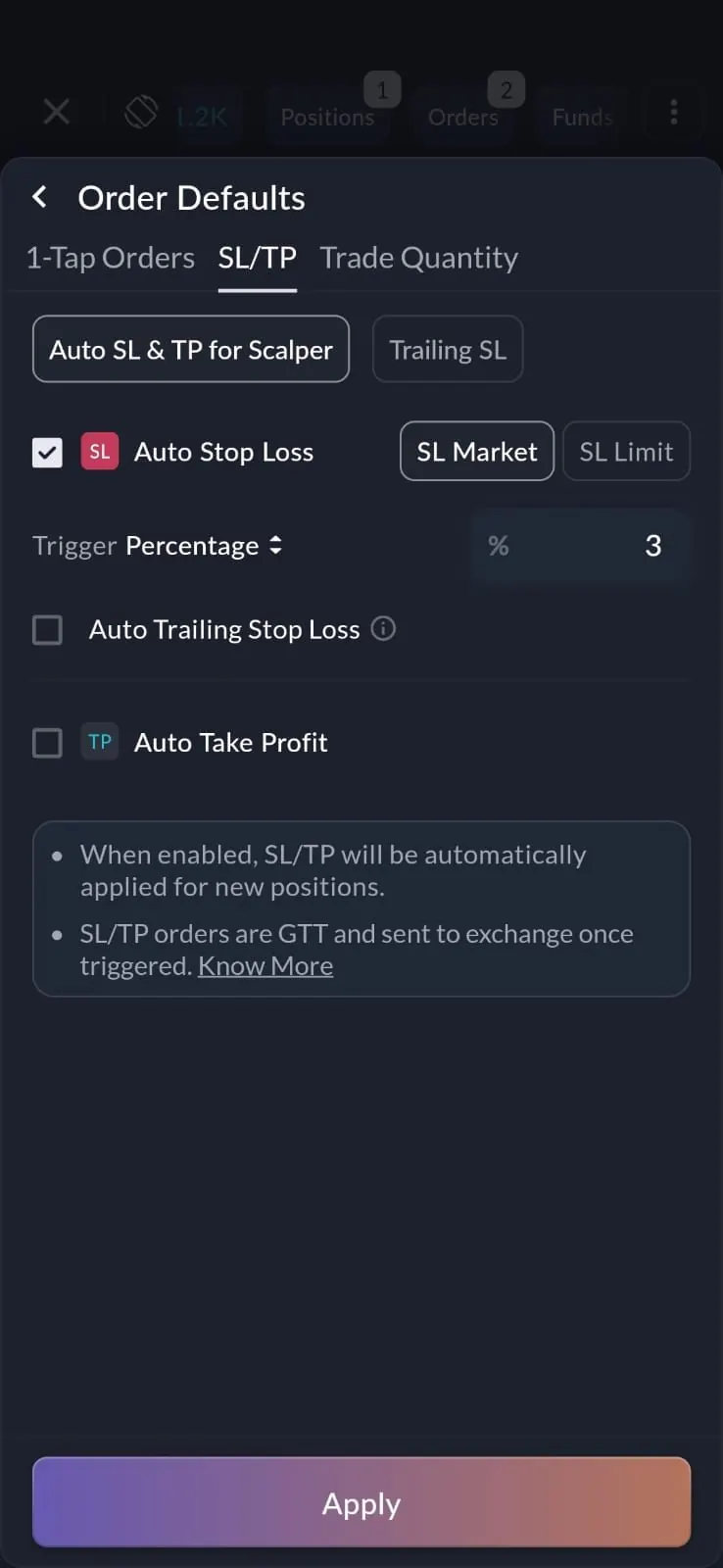
Points-based trailing stops are more common in derivatives trading (futures, options). Percentage-based trailing stops suit equity positions where the absolute price range changes over time. You can easily apply an auto trailing stop loss or a trailing stop loss on Sahi, on the charts directly at market or limit, to avoid slippage.
When a Trailing Stop Loss Works Best
Trailing stop losses perform best in trending markets. When a stock or index is making a sustained directional move, rising steadily with brief pullbacks—a trailing stop allows a trader to ride the trend without setting an arbitrary exit target.
They are particularly useful when:
- A trade has moved significantly into profit and you want to protect gains without closing the position manually
- You are trading during a session where you cannot monitor the screen continuously
- The instrument is in a clear trending phase rather than a sideways range
When a Trailing Stop Loss Can Work Against You
In choppy, sideways, or volatile markets, a trailing stop loss can trigger prematurely. If an index or stock whipsaws within a wide range, rising 200 points, falling 150 points, and rising again, a tight trailing stop may close the position on the pullback before the trend resumes.
Setting the trailing amount too narrow (e.g. 30 points on an instrument that moves 100 points in a normal session) leads to frequent exits on normal market noise. The trailing amount should be wider than the instrument's average intraday volatility to function effectively.
Trailing Stop Loss in Indian Markets
On NSE and BSE, trailing stop loss functionality is most commonly available through bracket orders (BO), a three-legged order that includes an entry, a target, and a trailing stop loss. Not all brokers offer bracket orders on all instruments. Availability varies by platform.
For manual trailing, adjusting a stop loss as the price moves, traders can modify an existing stop loss order through their broker's order management interface during market hours (9:15 AM to 3:30 PM IST on NSE trading days). SEBI-registered brokers are required to execute stop loss orders at the triggered price under the Securities and Exchange Board of India's order execution framework.
Frequently asked questions
What is a trailing stop loss?
A trailing stop loss is a dynamic stop loss order that automatically moves upward as a position's price rises, maintaining a fixed distance (in points or percentage) below the highest price reached. It locks in profits as a trade moves favourably and triggers a market or limit exit if the price reverses by the trailing amount. Unlike a fixed stop loss, it adjusts automatically without requiring manual updates.
How is a trailing stop loss different from a regular stop loss?
A regular stop loss is fixed at a single price level and does not move as the trade becomes profitable. A trailing stop loss adjusts upward automatically as the price rises, preserving a growing portion of profits. A regular stop loss is better for defining risk on a single price level; a trailing stop loss is better for riding a trending move while automating profit protection.
What trailing stop loss amount should I use?
The trailing amount should be wider than the instrument's normal intraday price range to avoid premature exits on market noise. For Nifty futures, traders commonly use trailing amounts of 50–150 points depending on the timeframe and volatility. For equities, a percentage-based trailing stop of 1–3% is commonly used. There is no universally correct amount — it depends on the instrument's volatility and the trade's timeframe.
Is trailing stop loss available in Indian brokers?
Trailing stop loss functionality is available through bracket orders (BO) on several NSE-registered brokers in India. Availability varies by broker, platform, and the specific instrument being traded. Some brokers offer trailing stop loss only on equity intraday trades and not on derivatives. Traders should check their specific broker's order types before relying on automated trailing stops.
Investments in the securities market are subject to market risks. Read all related documents carefully before investing. This post is for learning, not a recommendation.