Commodity Glossary Every Beginner Should Know
A plain-language glossary of every key commodity trading term used in India: margin, lot size, tender period, contango, backwardation and more.
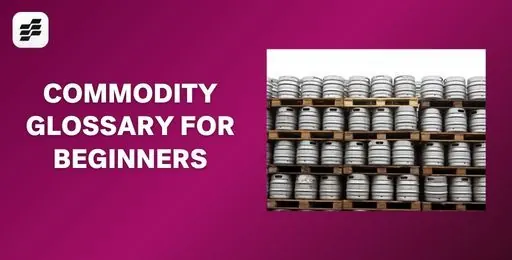
This glossary covers the core terms every beginner needs. Contract basics like lot size and margin. Mechanics like mark-to-market and the tender period. Participant types like hedgers and speculators. Price concepts like contango and backwardation. Know these terms cold, and every broker note gets far easier to read.
Commodity trading comes with its own vocabulary. Most of it isn't obvious from context. This commodity glossary covers the terms that actually come up. Grouped by theme, in plain language.
Trading Basics
- Commodity — A raw or basic good, like gold, crude oil or cotton. One unit swaps for another of the same type.
- Spot Price — The price for immediate delivery. Settled right away.
- Futures Contract — A deal to trade a commodity at a fixed price. Settled on a later date.
- Lot Size — The fixed quantity one contract represents. MCX crude oil, for example, is 100 barrels a lot.
- Bullion — Gold and silver, traded in set purity and lot sizes.
Contract Mechanics
- Margin — The deposit you pay to hold a position. Just a fraction of the contract's full value.
- SPAN Margin — The risk model exchanges use to set margin. It's based on recent volatility.
- Mark-to-Market (MTM) — The daily step that credits or debits your account, based on that day's price move.
- Expiry — The date a contract ends and settles. Either in cash, or through delivery.
- Rollover — Closing an expiring contract, then opening the same position in next month's contract.
{
  "type": "quiz",
  "slug": "commodity-glossary-margin-quiz",
  "label": "QUIZ",
  "question": "What is 'margin' in commodity futures trading?",
  "correctOptionKey": "B",
  "explanation": "Margin is the deposit paid to hold a futures position, just a fraction of the contract's full value, which is what makes futures trading capital-efficient but also risky.",
  "options": [
    {
      "key": "A",
      "text": "The exchange's annual membership fee"
    },
    {
      "key": "B",
      "text": "A deposit that's a fraction of the contract's full value"
    },
    {
      "key": "C",
      "text": "A tax paid on commodity profits"
    },
    {
      "key": "D",
      "text": "The broker's commission on each trade"
    }
  ]
}
Market Participants
- Hedger — A business trading to protect a real price risk. A refinery locking in crude oil costs, for instance.
- Speculator — A trader betting purely on price direction. No business need behind it.
- Arbitrageur — A trader who profits from small price gaps between linked markets. This keeps prices in line.
- Tender Period — The window before expiry, usually 3 to 5 days. A deliverable contract's delivery process starts here.
Price Concepts
- Contango — When futures trade above spot. Often due to storage costs.
- Backwardation — When futures trade below spot. Often a sign of tight near-term supply.
- Open Interest — The total open futures contracts, not yet settled or closed. A gauge of market participation.
- Circuit Limit — The biggest price move allowed in a session, before trading pauses.
{
  "type": "quiz",
  "slug": "commodity-glossary-contango-quiz",
  "label": "QUIZ",
  "question": "What does 'contango' mean in a commodity market?",
  "correctOptionKey": "A",
  "explanation": "Contango describes a situation where the futures price sits above the spot price, often because of storage costs for holding the physical commodity.",
  "options": [
    {
      "key": "A",
      "text": "Futures price trades above the spot price"
    },
    {
      "key": "B",
      "text": "Futures price trades below the spot price"
    },
    {
      "key": "C",
      "text": "The exchange is closed for the day"
    },
    {
      "key": "D",
      "text": "A trader has defaulted on payment"
    }
  ]
}
Clearing and Settlement
- Clearing Corporation — The body that guarantees every exchange trade. It becomes the counterparty to both buyer and seller.
- MCXCCL — MCX's own clearing corp. It settles and guarantees every MCX trade.
- NCCL — NCDEX's clearing corp, standalone since 2018.
- Physical Delivery — Settling a contract by actually transferring the commodity. Common in bullion and base metals.
- Cash Settlement — Settling a contract with a cash payment, against a set reference price. Used for crude oil and gas on MCX.
Want the full picture behind these terms? Read futures versus options and review risk management basics.
Sources: MCX and NCDEX contract specifications and clearing-corporation documentation; standard commodity-market terminology.
Frequently asked questions
What is lot size in commodity trading?
The fixed quantity of a commodity that one futures contract represents, like 100 barrels for MCX crude oil.
What is mark-to-market (MTM)?
Mark-to-market is the daily process of crediting or debiting your account based on that day's price move, keeping gains and losses settled continuously.
What is the difference between a hedger and a speculator?
A hedger trades to protect a real, existing business risk. A speculator bets purely on price direction, with no underlying business need.
What do contango and backwardation mean?
Contango is when futures trade above spot, often due to storage costs. Backwardation is when futures trade below spot, often signaling tight near-term supply.
What is the tender period?
The window before expiry, usually 3 to 5 days, when a physically-deliverable contract's delivery process begins.
Investments in the securities market are subject to market risks. Read all related documents carefully before investing. This post is for learning, not a recommendation.